

The Future of Rare Disease Commercialization Won’t Be Defined by Access Alone
Biopharmaceutical companies invest years of development, millions of dollars, and extraordinary scientific expertise to bring rare disease therapies to market.
Yet many continue to evaluate pharmacy partners using criteria built for a different era.
Distribution. Dispensing. Fulfillment.
While those capabilities remain essential, they are no longer enough. Which begs the question, how much longer can you afford to settle?
The rare disease landscape has fundamentally changed. Therapies are becoming increasingly specialized. Patient populations are increasingly vulnerable. Payers demand greater value. Regulators continue to emphasize the importance of Real-World Evidence (RWE) in the form of Patient Reported Outcomes (PROs) and Real-World Data (RWD) to better understand therapeutic impact beyond the clinical trial environment.
In this environment, the organizations that lead rare disease markets will not simply be those with the strongest clinical assets.
They will be the organizations that generate the strongest evidence and actionable data after approval.
The Most Overlooked Threat to Rare Disease Programs: The Evidence Gap
Rare diseases affect more than 300 million people globally and more than 30 million Americans. Yet fewer than 5% of known rare diseases have an approved treatment.
Every patient matters. Every patient journey matters. Every patient interaction creates an opportunity to learn.
Yet many rare programs struggle to answer critical questions once treatment begins:
-
- Are patients maintaining or improving function?
- What barriers are affecting adherence and persistence?
- What interventions are driving better outcomes?
- How is treatment impacting quality of life?
- What are caregivers experiencing?
- What evidence can support future payer, provider, and regulatory discussions?
For many rare programs, those questions remain unanswered. This is the rare disease evidence gap.
The rare disease evidence gap is the difference between what manufacturers learn during clinical development and what they are able to prove once therapies enter the real world. More importantly, it represents one of the largest untapped opportunities in rare disease commercialization. 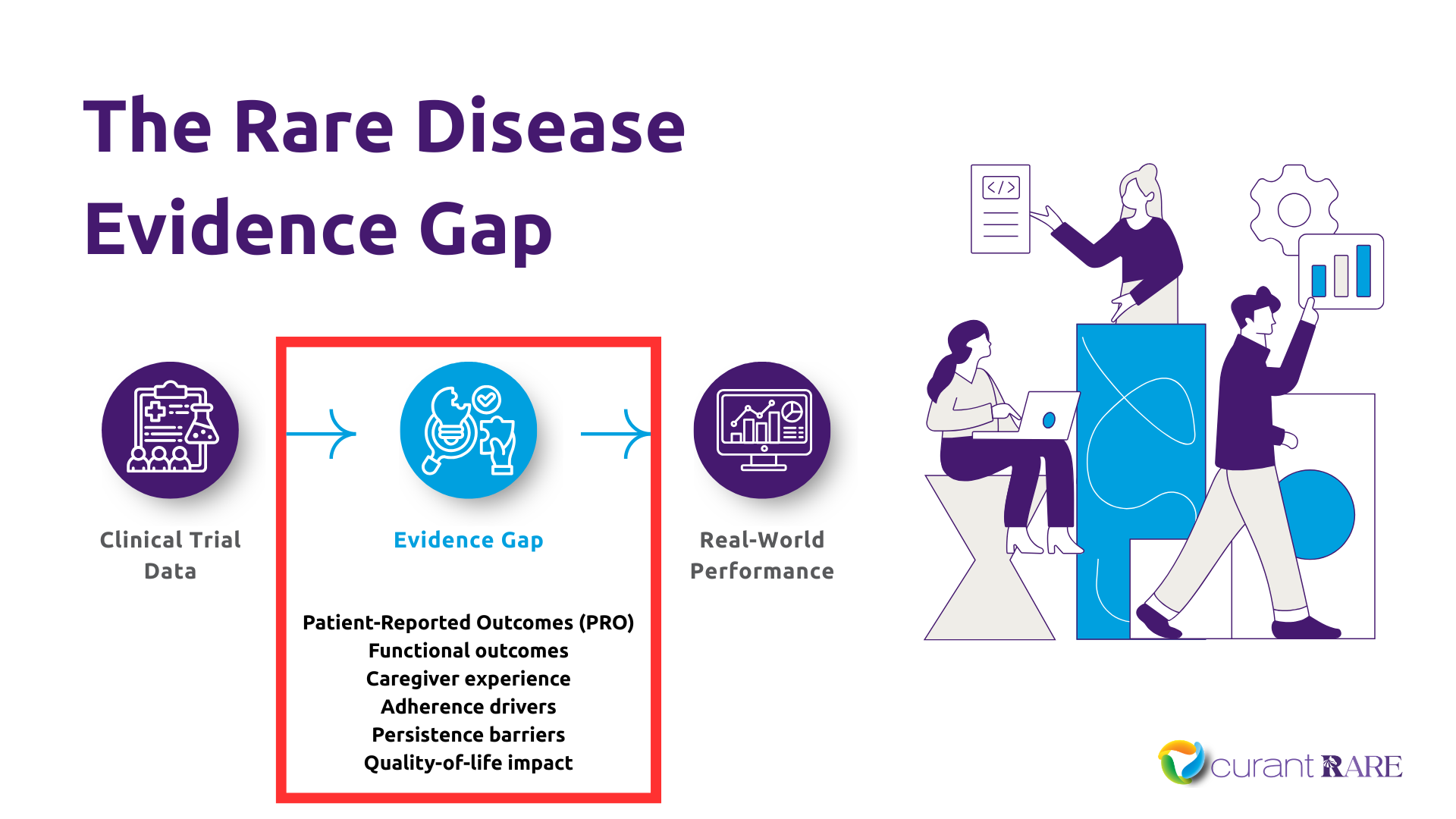
Every Rare Disease Patient Helps Advance Understanding
Historically, rare disease support programs have focused primarily on one objective: Getting patients onto therapy.
Every patient offers an opportunity to advance understanding in three (3) areas:
- The first area is access to therapy
- The second is adherence to treatment
- The third area is access to actionable insight
Every interaction has the potential to deepen understanding of disease burden, treatment effectiveness, PROs, caregiver experience, quality of life, and long-term therapeutic impact.
The most innovative programs recognize that these insights create value far beyond patient services. They strengthen market access strategies. They support health economics and outcomes research initiatives. They inform medical affairs. They enhance provider engagement. They help organizations better demonstrate value throughout the lifecycle of a therapy.
Simply put, evidence is becoming an opportunity in its own right.
Rare Disease Pharmaceutical Success Is Increasingly Determined After Approval
Clinical trials establish efficacy and safety. Commercialization proves it.
The programs that outperform in rare disease are not necessarily those which rely solely on being the most innovative therapy. They are the organizations that:
-
- Remove barriers faster
- Engage patients more effectively
- Improve persistence
- Capture meaningful evidence
- Generate actionable data
- Learn continuously from every patient interaction
That learning creates competitive advantage, and in a landscape where patient populations number in the hundreds or thousands, every insight matters.
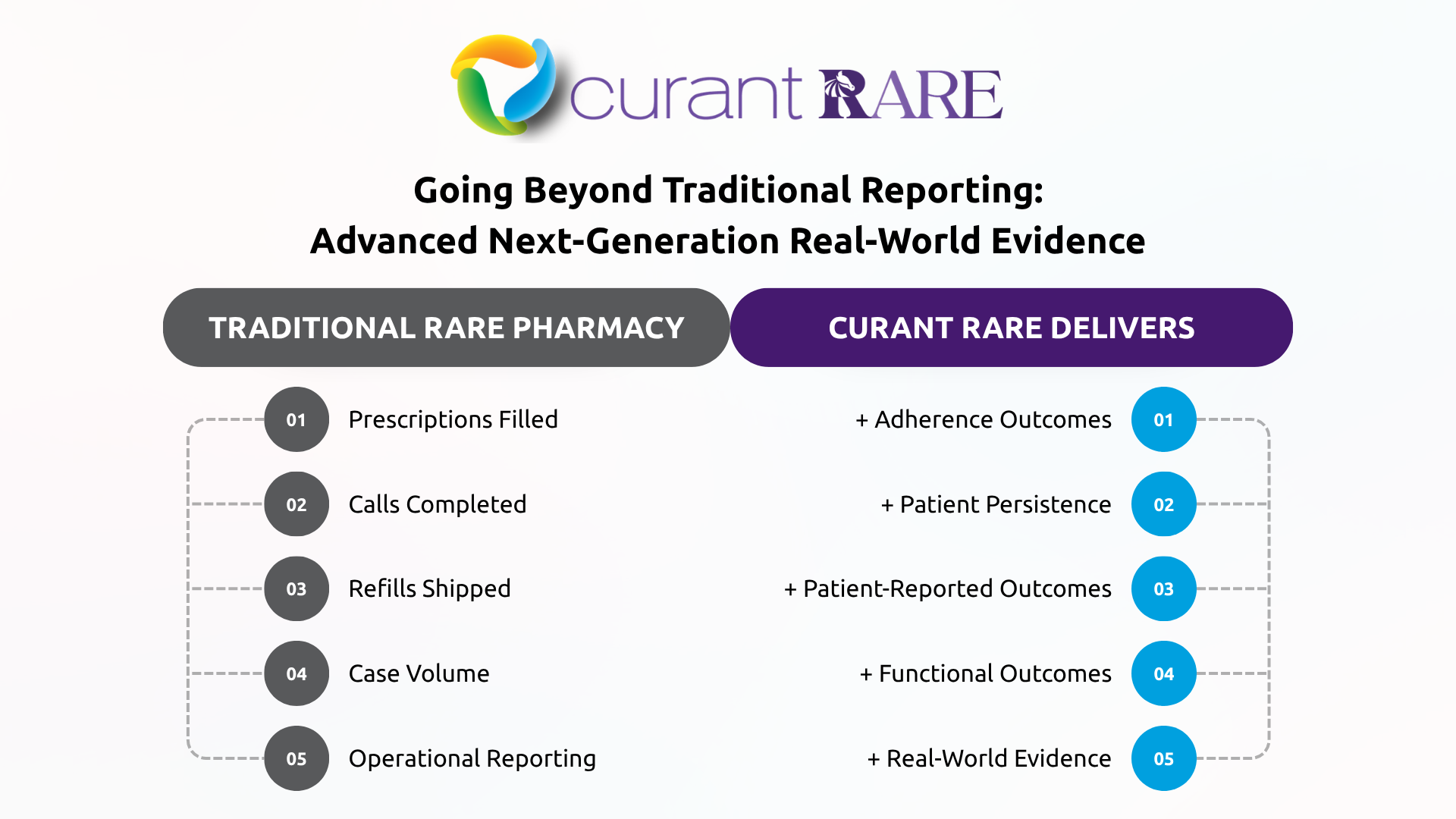
Traditional Rare Disease Programs Measure Activity. Gold Standard Programs Measure Activity, Performance and Impact.
Historically, pharmacy performance has been measured through operational outputs:
-
- Prior Authorization (PA) Turnaround Times
- Speed to Answer Patient/Caregiver Calls
- Final PA Approval Rates
These metrics describe activity. They do not explain outcomes. They do not reveal whether patients are thriving on therapy. They do not identify emerging barriers. And they do not generate the evidence manufacturers increasingly need to guide strategic decision-making.
The next generation of rare disease support requires a fundamentally different approach.
One that treats every patient’s interaction as an opportunity to improve care while simultaneously generating insight.
Traditional Pharmacies Measure Activity. Curant Rare Measures Impact.
This Is Where Gold Standard Programs Think Differently
At Curant Rare, we believe every patient interaction should generate more than a transaction. It should generate an opportunity to advance care, an opportunity to generate evidence.
Our purpose-built rare disease model combines dedicated therapy teams, proactive Medication Care Management®, and our proprietary MedPlan® Connect platform to create a real-time view of the patient journey.
The result is a model designed not only to support patients, but to continuously improve patient lives in a meaningful and measurable way. 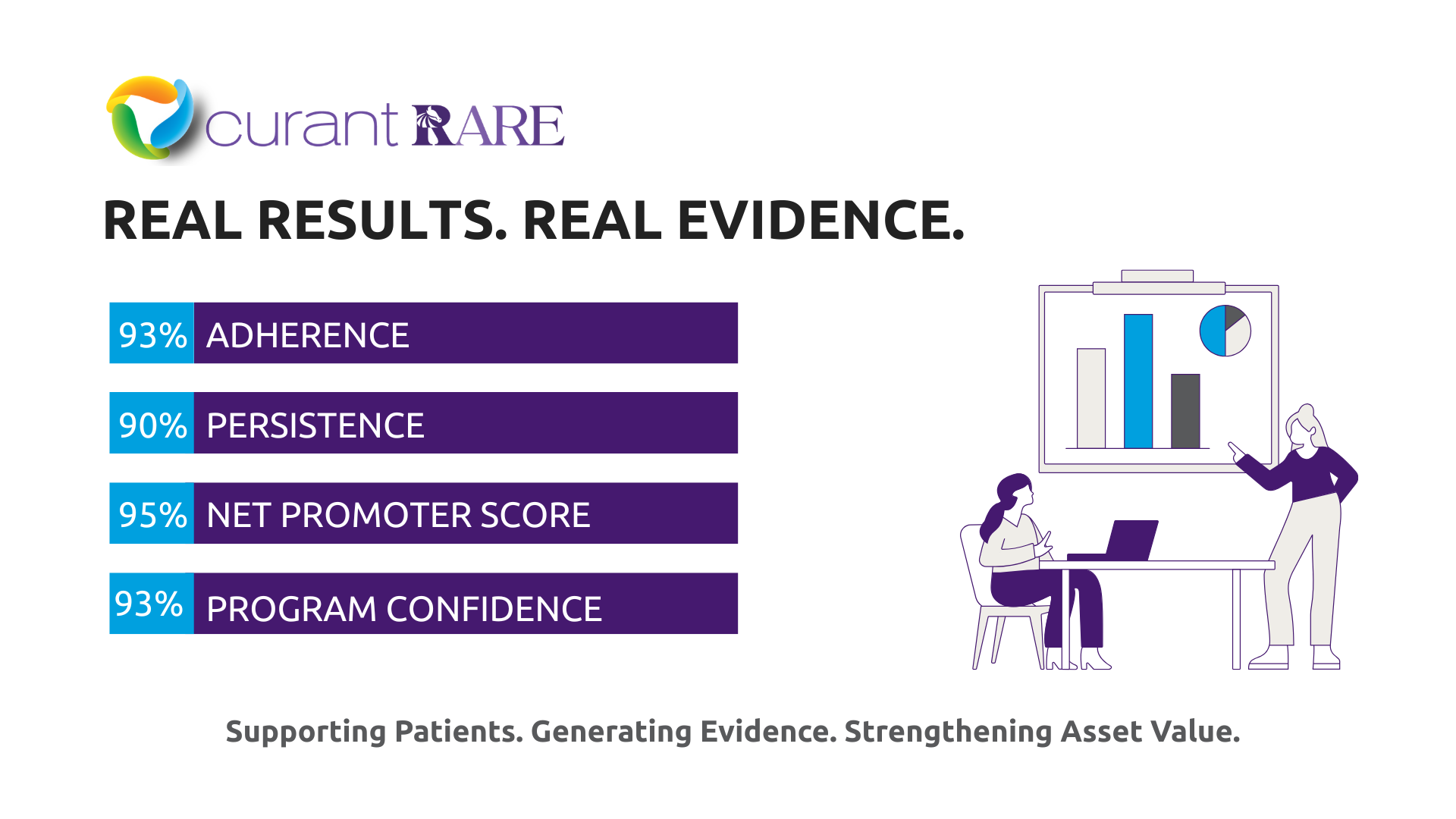
Current program performance includes:
-
- 93% adherence
- 90% persistence
- 93% program confidence
- Net Promoter Score of 95
Data on file. Current as of 2026.
These metrics represent more than operational excellence.
They represent patients remaining engaged, caregivers remaining supported, and manufacturer partners gaining confidence that the treatment experience matches the promise of the therapy.
Proof, Not Assumptions
Curant Rare’s commitment to evidence generation extends beyond operational metrics.
In a recent real-world evaluation involving patients with Niemann-Pick Disease Type C (NPC), a condition where preserving function is often a primary treatment objective, nearly 80% of patients demonstrated functional stability or improvement following treatment initiation.
Half achieved measurable functional improvement. Most notably, every patient demonstrated stability or improvement in at least one key functional domain. These findings do more than validate a support model, they generate meaningful evidence that helps manufacturers better understand treatment performance in real-world settings, strengthen stakeholder conversations, and build a more complete picture of therapeutic value.
Curant Rare is the Gold Standard for Real-World Evidence Rare Disease Partnerships
As discussed, therapies are becoming increasingly specialized. Patient populations are increasingly vulnerable. Payers demand greater value. Regulators continue to emphasize the importance of Real-World Evidence (RWE) in the form of Patient Reported Outcomes (PROs) and Real-World Data (RWD) to better understand therapeutic impact beyond the clinical trial environment.
In summary, the next era of rare disease leadership will not be defined solely by who develops the best therapies. It will be defined by who develops the best partnerships with the aligned mission of gold standard patient outcomes.
Get in Touch & Learn More Today!
Data Sources & References
- U.S. Food and Drug Administration (FDA). Real-World Evidence. FDA recognizes the importance of real-world data and real-world evidence in evaluating the safety, effectiveness, and value of therapies across the product lifecycle. [eurordis.org]
- U.S. Food and Drug Administration (FDA). Guidance Documents for Rare Disease Drug Development. FDA guidance highlights the growing role of patient-focused drug development, patient-reported outcomes, natural history studies, and real-world evidence in rare disease research and evaluation. [rarediseases.org]
- National Organization for Rare Disorders (NORD). Rare Disease Facts and Statistics. Approximately 30 million Americans are living with a rare disease, fewer than 5% of rare diseases have an approved treatment, and diagnostic journeys often exceed five years. [pubmed.ncb…lm.nih.gov]
- Rare Diseases International, EURORDIS, and Orphanet. New Scientific Paper Confirms 300 Million People Living with a Rare Disease Worldwide. Rare diseases collectively affect an estimated 300 million people globally, highlighting the substantial unmet need across the rare disease community.
- Wu J, Wang C, Toh S, Pisa FE, Bauer L. Use of Real-World Evidence in Regulatory Decisions for Rare Diseases in the United States: Current Status and Future Directions. Pharmacoepidemiology and Drug Safety. 2020;29(10):1213-1218. The authors describe the expanding role of RWE in rare disease regulatory decision-making and the importance of patient experience data in understanding treatment impact. [rarediseaseday.org]
- Curant Rare. Specialty Pharmacy Transition Flipbook and Program Performance Data (Data on file; current as of March 2026). Includes adherence (93%), persistence (90%), program confidence (93%), Net Promoter Score (95), transition outcomes, and Niemann-Pick Disease Type C real-world evidence findings.